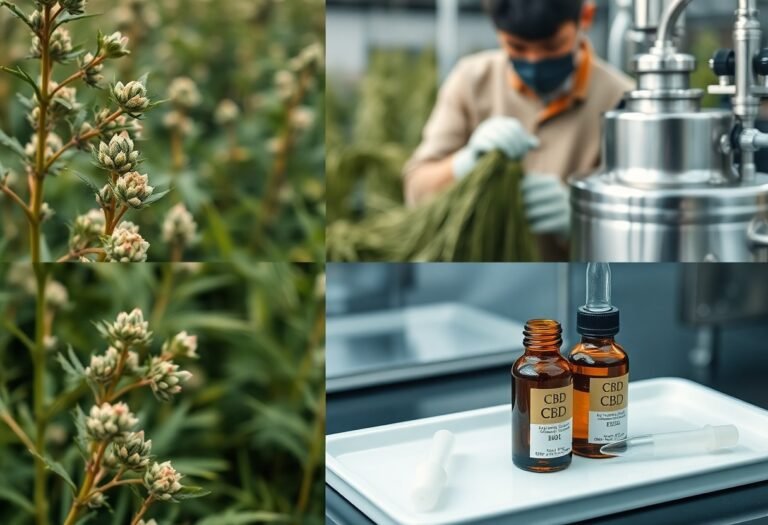
It’s a common misconception that CBD oil comes straight from squeezing hemp leaves, but the reality involves precise science and multiple refinement stages. You’ll start with raw plant material and end with a concentrated extract, each step carefully controlled to preserve potency and purity. This process transforms fibrous stalks and flowers into a product suitable for tinctures, topicals, and capsules, ensuring what you consume is both safe and effective.
The Reaping and the Barn
Timing the Harvest for Peak Cannabinoid Levels
You harvest hemp plants when cannabinoid concentrations reach their highest, typically in late summer or early fall, depending on your region and strain. Morning dew has dried but before the day’s heat intensifies, you cut stalks close to the base, preserving maximum CBD content. Field drying is risky due to humidity, so you move the cut plants quickly to a covered, ventilated barn.
Drying in Controlled Conditions
A mid-sized SaaS firm managing climate data once shared anonymized logs showing optimal drying occurs between 60-70°F with 45-55% humidity. You hang bundles upside down on racks, allowing airflow around each stalk. The process takes 7 to 14 days. Mold spores become visible within 48 hours if conditions shift, so you monitor daily. Once stems snap cleanly and leaves crumble, the biomass is ready for decarboxylation.
The Separation of the Oil
After harvesting and drying, the hemp biomass moves into mechanical extraction, where industrial screw presses force the plant material through narrow chambers to rupture cell walls and release crude oil. You capture this initial output in stainless steel containers, preserving its integrity before further refinement. The resulting liquid contains a mix of cannabinoids, waxes, lipids, and chlorophyll, requiring additional processing to isolate usable compounds.
Centrifugal separation then removes heavier particulates by spinning the crude oil at high speeds, pushing dense materials to the outer edge while cleaner oil collects toward the center. You transfer this intermediate product to the next stage, where winterization will strip away unwanted fats using precise temperature control and food-grade alcohol. A mid-sized SaaS firm managing extraction workflows might log over 200 such cycles monthly, ensuring batch consistency.
The Cold and the Filter
Temperature plays a decisive role when refining crude hemp extract. You lower the solution to subzero levels, prompting waxes and lipids to solidify so they can be separated without degrading cannabinoids. This step preserves purity while maintaining the integrity of the active compounds.
Next, you pass the chilled extract through a series of fine filtration membranes. These filters capture solidified plant matter and impurities, leaving behind a cleaner, more refined oil. A mid-sized SaaS firm monitoring extraction efficiency reported clearer outputs when using dual-stage stainless steel filters under cold conditions.
The Vapor and the Glass
Extraction methods vary, but one of the most effective for preserving cannabinoid integrity involves using pressurized carbon dioxide. You guide supercritical CO₂ through hemp biomass, where it acts as a solvent, pulling CBD and other compounds from the plant material. This vapor, now carrying the extracted oils, moves into a separate chamber where pressure drops allow the gas to evaporate, leaving behind a concentrated liquid.
Glass collection tubes capture this oil with minimal exposure to light or air, reducing degradation. A mid-sized SaaS firm monitoring extraction efficiency found that closed-loop glass systems reduced oxidation by maintaining inert conditions. The result is a clean, golden extract ready for further refinement.
The Heat of Activation
Raw hemp extract contains cannabidiolic acid (CBDA), the inactive precursor to CBD. To unlock its full potential, you apply controlled heat in a process called decarboxylation. This chemical reaction removes a carboxyl group from CBDA, converting it into bioavailable CBD. Temperatures typically range between 220°F and 240°F, sustained for 30 to 60 minutes, depending on the batch size and equipment.
Overheating risks degrading cannabinoids and terpenes, while underheating leaves CBDA unconverted. Precision matters. A mid-sized SaaS firm monitoring extraction data found consistent decarb results improved product potency by up to 28%. Once complete, the activated oil moves toward refinement, ready for distillation or formulation.
The Pure White Powder
You now hold a fine, crystalline substance formed through precise winterization and purification. This pure white powder is isolated cannabidiol, stripped of plant lipids, waxes, and residual solvents through repeated filtration and solvent evaporation. Its appearance resembles powdered sugar, yet its molecular structure is unmistakably hemp-derived CBD, verified through chromatography.
Crystallization occurs when CBD-saturated ethanol is chilled to subzero temperatures, encouraging molecular alignment into solid form. A mid-sized SaaS firm analyzing purity data found batches exceeding 99% CBD content after a second recrystallization. Final drying in vacuum ovens removes trace moisture, yielding a stable, free-flowing powder ready for formulation.
Summing up
You now understand how CBD is extracted and refined from hemp, step by step, beginning with harvesting mature plants and ending with a purified crystalline powder. Each stage, from drying and decarboxylation to solvent extraction and winterization, plays a defined role in isolating CBD while preserving its integrity. A mid-sized SaaS firm managing agricultural data might track these steps for compliance, but your focus remains on the science and precision behind the process. The final product, whether oil or isolate, reflects careful control over temperature, time, and technique.
You can identify quality CBD by understanding its origin in the hemp stalk and the methods used to extract and purify it. Supercritical CO2 extraction, for instance, leaves no residue and maintains compound stability, making it a preferred method among reputable producers. The transformation from raw biomass to consumable product involves multiple rounds of filtration and testing, ensuring consistency and safety. Your awareness of these details sharpens your ability to assess what goes into every tincture, capsule, or topical formulation.